Restore Healthy Blood Flow with Venous Recanalization in Mohali
When veins become blocked due to clots or chronic venous disease, consequences include leg swelling, pain, venous ulcers, and pulmonary embolism. Dr. Ravul Jindal offers minimally invasive venous recanalization at Fortis Hospital Mohali, restoring healthy circulation without major surgery.
Dr. Ravul Jindal offers minimally invasive venous recanalization at Fortis Hospital Mohali, restoring healthy circulation without major surgery. With over 30 plus years of vascular surgery expertise and training from London's St. Mary's Hospital, he is the region's most trusted specialist for complex venous interventions.
95%
Clinical Success Rate
What Is Venous Recanalization?
Venous recanalization is a catheter-based, minimally invasive procedure that reopens veins narrowed or blocked by clots or scarring. The goal is restoring normal venous outflow, relieving downstream pressure that causes swelling, pain, and tissue damage.
Unlike open surgery, this procedure requires only a small skin puncture. Using fluoroscopy and imaging, specialists deploy balloon venoplasty, venous stenting, thrombolysis, or mechanical thrombectomy - often combining techniques in one sitting for optimal venous patency.
When Your Veins Send Warning Signals
Chronic venous obstruction often goes undiagnosed, as symptoms are mistaken for fatigue or aging. Early consultation with Dr. Ravul Jindal can prevent irreversible limb damage.
Persistent Leg Swelling: Edema that doesn't improve with elevation or rest.
Chronic Leg Heaviness: Aching or tightness worsening after prolonged standing.
Skin Changes: Darkening, thickening, or hardening around the ankle area.
Venous Ulcers: Open, slow-healing wounds appearing on the lower leg.
Sudden Leg Pain: Rapid swelling suggesting a possible acute DVT episode.
A Step-by-Step Look at the Venous Recanalization Procedure
Venous recanalization is a sophisticated endovascular procedure designed to restore blood flow in chronically blocked veins using minimally invasive techniques, specialized imaging, and advanced stenting technology.
Step 1: Pre-Procedure Evaluation
Advanced imaging including duplex Doppler, CT venography, or IVUS precisely maps the location, extent, and nature of venous blockage before the intervention begins.
Step 2: Vascular Access
A thin catheter is inserted through a small skin puncture at the groin or knee under ultrasound guidance—requiring no large incisions or general anaesthesia.
Step 3: Crossing the Blocked Segment
Specialized guidewires and catheters navigate through the obstructed vein, carefully establishing a working channel across the completely blocked or scarred segment.
Step 4: Balloon Venoplasty
An angioplasty balloon is advanced to the narrowed site and gently inflated to widen the vessel and break down restrictive fibrous scar tissue.
Step 5: Venous Stent Placement
Where vein re-collapse is likely—especially in May-Thurner syndrome—a dedicated venous stent is deployed to maintain structural integrity and long-term patency.
Step 6: Recovery and Discharge
Most patients need only a 1-2 day hospital stay, followed by anticoagulation therapy and compression stockings, returning to light activities within days.
Benefits of Minimally Invasive Venous Recanalization
Venous recanalization delivers life-changing relief from chronic venous disease - with significantly lower risks, faster recovery, and sustained long-term results compared to open surgical alternatives.
Small skin puncture only - no open incision or stitches required
Shorter hospital stay of just 1–2 days post-procedure
Significantly lower risk of infection and surgical complications
Faster return to normal daily activities and mobility
Sustained reduction in leg swelling, pain, and discomfort
Dramatically lowers venous ulcer recurrence in long-term follow-up
Clinical Success
95%+
Reported Clinical Success
Insurance Support
EMI Options Available
Life-changing relief through advanced, incision-free venous intervention.
Post-Procedure Care and Long-Term Follow-Up
Successful outcomes depend equally on post-procedural management. After venous recanalization, a structured care plan is implemented to ensure the longevity of the intervention and prevent future complications.
Anticoagulation therapy (blood thinners) for a defined period based on individual clot risk.
Medical-grade compression stockings to provide external support and improve venous return.
Scheduled Doppler ultrasound follow-ups to monitor stent patency and overall vein health.
Lifestyle guidance focusing on proper hydration, activity levels, and weight management.
Regular clinical review to assess symptom relief and adjust long-term medication if necessary.
Conditions Treated with Venous Recanalization
Dr. Ravul Jindal offers venous recanalization for a wide spectrum of venous occlusive conditions, treating both acute and chronic cases with precision and expertise.
Deep Vein Thrombosis (DVT)
Acute and chronic blockages in the legs or pelvis.
Post-Thrombotic Syndrome (PTS)
Persistent limb disability and swelling resulting from long-term DVT.
May-Thurner Syndrome
Compression of the left iliac vein by an overlying artery, leading to clots.
Iliofemoral Venous Obstruction
Significant blockages in the outflow veins of the pelvis and thigh.
Chronic Venous Insufficiency (CVI)
Addressing deep venous outflow obstruction as the underlying driver of CVI.
Why Choose Dr. Ravul Jindal for Venous Recanalization in Mohali
With over 30 years of vascular surgery experience and advanced training at London's St. Mary's Hospital (Imperial College), Dr. Ravul Jindal is the region's most trusted venous intervention specialist.
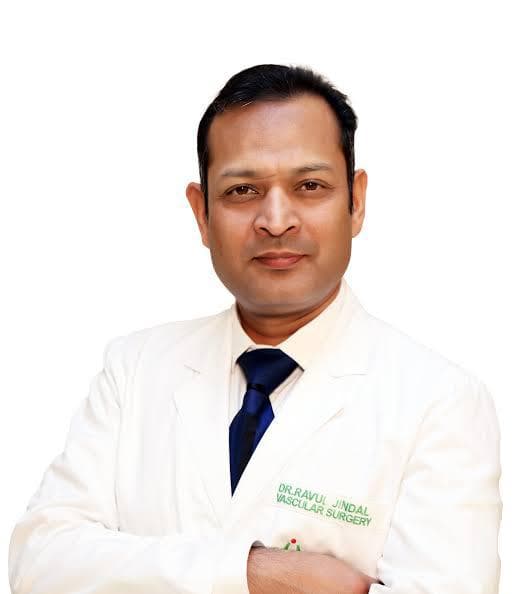
"Patients across Punjab, Chandigarh, Panchkula, Himachal Pradesh, and J&K choose Dr. Ravul Jindal for precise, reliable, and lasting venous disease treatment."
Expertise
Clinical Legacy
Experience: 30+ years in advanced vascular and endovascular surgery.
International Training
Fellowship: Advanced vascular training at St. Mary's Hospital, London.
Institutional Leadership
Director: Heading Vascular Surgery at Fortis Hospital Mohali for 16+ years.
Technological Edge
Technology: State-of-the-art cath lab and IVUS (Intravascular Ultrasound) imaging.
Surgical Volume
High-Volume Center: Thousands of complex venous cases successfully performed.
Patient Care Model
Approach: Personalized diagnosis, treatment, and structured long-term follow-up.
Frequently Asked Questions
1. Who is Dr. Ravul Jindal and why is he trusted for venous recanalization?
2. Is Mohali a good destination for venous recanalization treatment?
3. What conditions can be treated with venous recanalization?
4. How long does recovery take after venous recanalization?
5. Is venous recanalization a painful or risky procedure?
6. What does venous recanalization treatment cost in Mohali?
Book Your Venous Consultation Today
Don't let chronic venous obstruction limit your life. Get expert help from Dr. Ravul Jindal at Fortis Hospital Mohali.