Stages of varicose veins

Stages of Varicose Veins: A Complete Medical Guide by Dr. Ravul Jindal
If you have noticed twisted, bulging veins on your legs that cause heaviness, discomfort, or pain, you may be experiencing varicose veins — a progressive condition that should never be dismissed as purely cosmetic. As a vascular surgeon with years of clinical experience treating vein disease across patients in India, I see far too many cases where the condition has been ignored until it reaches an advanced and difficult-to-treat stage.
Varicose veins are abnormal enlargements and twisting of veins beneath the skin surface, most commonly in the legs. They develop when the small valves inside veins fail to close properly, causing blood to pool rather than flow back toward the heart. Over time, this pooling leads to venous hypertension — elevated blood pressure within the veins — which drives the progressive deterioration known as chronic venous insufficiency (CVI).
According to clinical data, approximately 10%–30% of adults worldwide suffer from varicose veins, with women being more commonly affected, particularly following pregnancy or with advancing age. In clinical practice, I also see a significant number of patients in cities like Chandigarh, Mohali, and across Punjab who present late — often at Stage 4 or beyond — simply because they were unaware that their vein condition would worsen without treatment.
Understanding the stages of varicose veins is the first step toward protecting your leg health. Doctors classify vein disease into six clinical stages (C1–C6) based on visible symptoms and severity, a system endorsed by the European Society of Vascular Surgery and the National Institute of Clinical Excellence.
What Causes Varicose Veins to Progress?
Vein disease progresses when the small valves inside the veins fail, allowing blood to flow in the wrong direction — away from the heart — and pool in the lower limbs. This buildup increases pressure on the vein walls, causing them to swell and stretch. Several risk factors accelerate this process, including family history, obesity, sedentary lifestyle, menopause, and repeated pregnancy. Without timely intervention, the condition moves from mild cosmetic concerns to serious complications involving the skin and underlying tissue.
The 6 Stages of Varicose Veins (C1–C6)
Stage 1 – Spider Veins / Telangiectasias (C1)
The earliest stage of varicose veins presents as telangiectasia — fine capillary veins visible just beneath the skin. These appear as thin threads, webs, or branching patterns in shades of red, purple, or blue, most commonly on the legs and face.
At this stage, most patients experience no significant symptoms, though some report mild itching or a burning sensation. The primary concern is cosmetic, but this is an important early warning sign that deeper vein issues may be developing beneath the surface. Venous insufficiency, family history, pregnancy, and a sedentary lifestyle all contribute to this stage.
Patients often ask me, "Doctor, these are just small veins — do I really need to worry?" My answer is always the same: early identification saves you from far more serious problems down the road.
Stage 2 – Visible Varicose Veins (C2)
By Stage 2, the veins in the subcutaneous layer become curved, twisted, and visibly prominent. These enlarged, swollen veins are often purple or blue in colour and can cause heaviness in the calves, cramps, muscle pulling, aching, itching, burning, numbness, or fatigue — particularly after prolonged sitting or standing.
Many patients dismiss this stage, believing treatment is optional. In clinical practice, I emphasise that getting varicose vein treatment at Stage 2 can stall the progression of vein disease, preventing the more complex and potentially deadly complications that arise later. Sclerotherapy and endovenous laser treatment are highly effective at this stage.
Stage 3 – Swelling / Varicose Veins With Symptoms (C3)
Stage 3 is where chronic venous insufficiency begins to visibly affect the body. The legs and ankles start to swell as the damaged veins lose their ability to reabsorb fluid efficiently. Patients report persistent heaviness, cramping, aching, and a throbbing feeling, and the skin around the veins may feel warm or tender.
This is considered an advanced stage of vein disease that can significantly reduce quality of life. Additional symptoms include muscle spasms, tightness in the calves, and pain while walking. Elevation of the legs may temporarily relieve symptoms but will not treat the underlying condition — medical treatment is essential at this point.
Stage 4 – Skin Discolouration / Lipodermatosclerosis (C4)
At Stage 4, the congestion of blood in the veins begins to visibly damage the skin. A condition known as Lipodermatosclerosis develops, where the fatty tissue beneath the skin becomes inflamed and stained, causing the skin to appear brown or white in patches.
The skin texture becomes dryer and more brittle, making it highly vulnerable to breakage, injury, and bleeding. Chronic inflammation is especially pronounced above the ankle. The skin grows tight and shiny, and by this stage, most patients experience pain and itchiness on a daily basis. Compression stockings and leg elevation can help manage symptoms, but medical treatment is necessary to halt progression.
Stage 5 – Healed Ulcers / Skin Changes with Scars (C5)
Stage 5 marks a critical turning point. Here, venous insufficiency causes open sores and ulcers to form — most commonly around the ankles. These ulcers are a result of insufficient blood flow breaking down skin tissue, preventing the delivery of the nutrients necessary for natural healing.
The most frequent type is venous stasis, an open wound caused by pooled blood beneath the skin. Patients in this stage may develop scars from healed wounds, and the skin appears discolored, hard, or thin. Clinical evidence also shows that those with untreated varicose veins are five times more likely to develop deep vein thrombosis (DVT) — a blood clot that is potentially fatal. Skin care, wound management, and specialist vein treatment are critical at this stage.
Stage 6 – Active Venous Ulcers (C6)
Stage 6 is the most serious and advanced stage of varicose veins. Active venous ulcers develop on the legs, particularly around the ankles. These wounds are characterised by an uneven edge, a deep, damp and red centre, and surrounding skin showing chronic inflammation.
These ulcers heal slowly, are highly prone to bacterial infection, and cause excruciating pain that limits a patient's ability to walk and perform normal daily activities. Managing Stage 6 requires a combination of wound care, compression therapy, radiofrequency ablation, foam sclerotherapy, and direct treatment of the underlying vein condition.
Treatment Options Across All Stages
Modern minimally invasive procedures have transformed varicose vein treatment, making it safer and more effective than traditional surgery. Based on the stage of vein disease, the following options are available:
Thermal ablation techniques include Endovenous Laser Treatment (EVLA) and Endovenous Radiofrequency Ablation (EVRFA), which use heat to close faulty veins and redirect blood flow to healthier veins. Non-thermal options include sclerotherapy, foam sclerotherapy, and endovenous cyanoacrylate closure. These procedures leave a small wound of just 2–3 mm, result in minimal discomfort, carry a reduced risk of complications, and can be performed on an outpatient basis.
For advanced vein disease (C3–C6), ulcer management through wound care and compression therapy is also incorporated into the treatment plan.
The key message is this: Varicose Veins are far easier to treat when identified early. Do not wait until you reach Stage 5 or 6 to seek help.
Book a Consultation with Dr. Ravul Jindal - Vascular Surgeon, Fortis Hospital Mohali
Book your consultation while you read.
Recent Insights


Frequently Asked Questions
What are the first signs of varicose veins?
Can varicose veins go away on their own without treatment?
At what stage of varicose veins should I see a doctor?
What is the best treatment for varicose veins in India?
Related Articles

Sclerotherapy for Varicose Veins: Procedure, Benefits, and Recovery

Laser Treatment for Varicose Veins: How Does EVLA Work?

How to Prevent Varicose Veins in Legs During Pregnancy
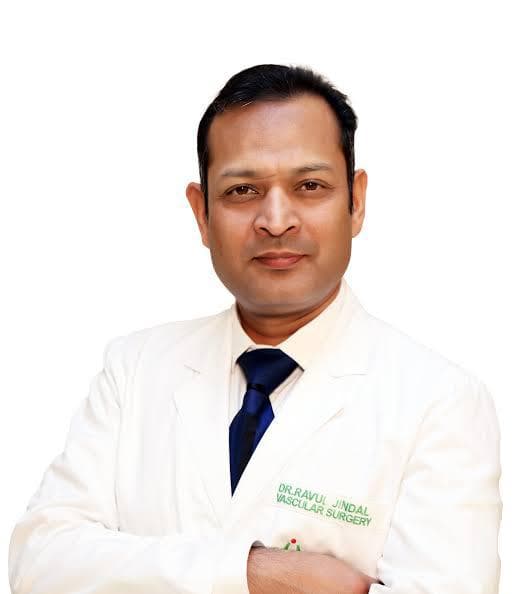
Dr. Ravul Jindal Team
Director, Vascular & Endovascular Surgery
MBBS, MS (General Surgery), FRCS (Edinburgh), DNB, FIVS (Fellow of India Vascular Surgery)
Director of Vascular Surgery at Fortis Hospital Mohali with 30+ years of experience in varicose veins, DVT, diabetic foot, and endovascular surgery.